Can AI Really Diagnose Your Car? What Smart Diagnostics Mean for Coventry Drivers
A check engine light can make any driver nervous. You may plug in a code reader, open an AI-powered automotive app, and receive an answer within seconds. Sometimes the result sounds reassuringly specific: “Replace the oxygen sensor” or “Faulty catalytic converter.”
But is that a complete diagnosis?
Not usually.
Modern technology has made vehicle diagnostics and repair faster and more informed, but artificial intelligence and code readers are not replacements for a trained technician. They are tools that help organize information and identify possible causes. The important work comes next: testing the vehicle, confirming the fault, and deciding what repair is actually needed.
For drivers in Coventry and surrounding communities, understanding that difference can help you avoid unnecessary parts, wasted money, and repairs that do not solve the original problem.
What AI-assisted vehicle diagnostics can do
Today’s diagnostic equipment can communicate with the computers and control modules inside your vehicle. Depending on the vehicle and scan tool, it may retrieve trouble codes, display live sensor data, monitor system performance, and help identify patterns connected to a drivability concern.
AI-assisted systems can add another layer by quickly comparing symptoms and codes with large databases of known problems. They may help:
- Organize possible causes of a fault
- Suggest which tests a technician should perform first
- Identify patterns that appear across similar vehicles
- Translate technical codes into easier-to-understand language
- Highlight issues that may need immediate attention
That can save time. Instead of starting with a completely blank page, a technician may have a more focused list of systems or components to investigate.
However, “possible cause” is not the same as “confirmed failure.”
A diagnostic system can tell you that a sensor signal is outside its expected range. It cannot automatically prove whether the sensor itself has failed, whether the wiring is damaged, whether a connector is corroded, or whether another problem is causing the unusual reading.
A trouble code is a starting point, not a repair order
One of the most common misunderstandings about car diagnostics is treating a trouble code as a direct instruction to replace a part.
For example, a code related to an oxygen sensor may be caused by:
- A failed oxygen sensor
- An exhaust leak
- A wiring or connector problem
- An intake leak
- A fuel delivery issue
- An engine misfire
- A problem elsewhere that is affecting the sensor reading
The code identifies a condition the vehicle computer has noticed. It does not always identify the root cause.
Think of it like a smoke alarm. The alarm tells you that something may be wrong, but it does not tell you whether the source is burnt toast, an overheated appliance, or a serious fire. You still need to investigate.
The same principle applies to check engine lights, ABS warnings, airbag lights, transmission codes, and other electronic alerts. Replacing the first part named by an app may turn off the warning temporarily: or may do nothing at all.
Why a parts-store code reader cannot fully diagnose your car
Many parts stores offer free code scans, and a basic scan can be useful. It may confirm that a fault has been stored and provide information you can share with a repair shop.
But a basic code reader typically has limitations. It may only access a portion of the vehicle’s systems and provide a generic code description. It may not be able to perform advanced tests, communicate with every control module, or show the information needed to evaluate a complicated intermittent problem.
A phone app connected to an inexpensive plug-in device can have similar limitations. It may be convenient for reading certain engine codes, but it cannot physically inspect your vehicle or verify a repair.
A code reader also cannot:
- Hear a bearing or belt making an unusual noise
- Feel a vibration during a road test
- Inspect a damaged wire or loose ground
- Measure fuel pressure or mechanical compression
- Check for a vacuum or exhaust leak
- Confirm whether a component operates correctly under load
- Determine whether a repair has fully resolved the problem
That is why a code scan can be helpful information without being a complete diagnosis.
Where a technician’s experience still matters
AI can process information quickly, but vehicle diagnosis is not only a data exercise. Cars operate in the real world, where weather, road conditions, maintenance history, age, corrosion, previous repairs, and driving habits all affect how problems appear.
An experienced technician knows how to connect those details.
A driver may describe a hesitation only when accelerating uphill. Another may notice that a warning light appears after the vehicle warms up. Someone else may report that the car starts normally in the morning but struggles after a short trip. These details can change the diagnostic direction.
A technician can also compare what the scanner reports with what the vehicle is actually doing. That may involve a visual inspection, electrical testing, live-data analysis, a road test, or an active test that checks how a component responds.
At Moore’s Motor Service, our experience goes back to 1927. Over four generations, we have worked on vehicles as automotive technology has changed from simple mechanical systems to highly computerized cars and trucks. Modern scan tools are important, but they work best when paired with practical knowledge and careful judgment.
How proper vehicle diagnostics and repair works
A thorough diagnostic process usually follows several steps.
1. Listen to the concern
The symptoms you notice are valuable. When did the problem begin? Does it happen when the engine is cold or warm? Does it occur during braking, acceleration, turning, or starting? Has any recent work been performed?
These details help establish a direction before testing begins.
2. Scan the vehicle
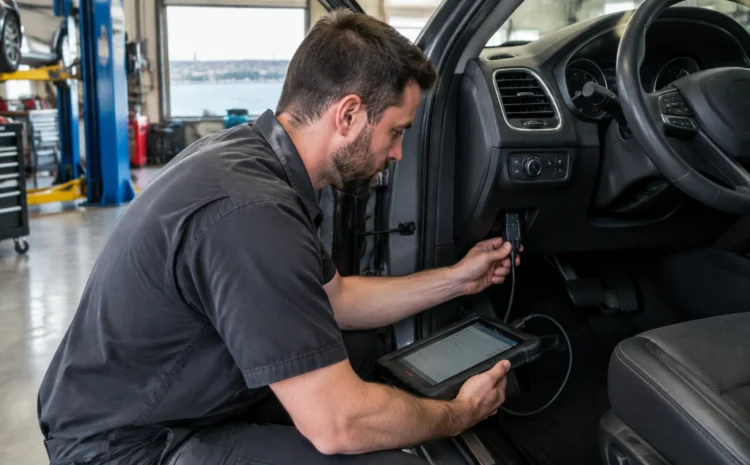
A professional scan tool can retrieve stored, pending, and manufacturer-specific codes when supported by the vehicle. It may also show live data from multiple systems and help identify conditions that are not visible from a basic code reader.
3. Inspect related systems
The technician checks the components connected to the code or symptom. That can include wiring, connectors, hoses, grounds, fuses, fluids, mechanical components, and signs of physical damage.
4. Perform targeted tests
The right test depends on the problem. Testing may include voltage and resistance checks, pressure measurements, circuit testing, actuator commands, or other procedures designed to separate one possible cause from another.
5. Test-drive and verify
Some problems only appear while driving. A test drive can help reproduce a vibration, hesitation, shift concern, noise, or warning light. After a repair, verification helps confirm that the original issue has been corrected and that no additional concerns remain.
This process may take more time than plugging in a scanner, but it can prevent the even greater expense of replacing parts based on a guess.

When smart diagnostics can save you money
Good diagnostic technology can save money when it helps a technician find the right direction quickly. It can reduce unnecessary testing, identify related system faults, and reveal problems before they lead to more serious damage.
For example, a warning light may prompt an inspection before a small issue affects the catalytic converter, transmission, or engine. A scan may also help identify a problem that would be difficult to locate through visual inspection alone.
Diagnostics are especially valuable when:
- The check engine light is on
- Several warning lights appear at once
- The vehicle has reduced power
- The engine is misfiring or running unevenly
- The transmission is shifting abnormally
- The vehicle has an intermittent starting issue
- A problem continues after another repair
- You are buying a used vehicle and want its systems evaluated
The goal is not simply to retrieve a code. The goal is to find the cause so you can make an informed repair decision.
When AI or a code reader can point to the wrong part
Technology becomes less reliable when the available information is incomplete. An app may not know about a recent repair, a weak battery, a modified exhaust system, water intrusion, or an intermittent wiring fault. It may also rank the most common failure rather than the failure affecting your particular vehicle.
That can lead to parts swapping: replacing one component after another without confirming the cause.
In some cases, clearing a code can make the problem appear to be gone. The warning light may stay off until the vehicle completes its self-checks again. Clearing the code does not repair the underlying issue, and it may also erase useful diagnostic information.
If your vehicle has a flashing check engine light, severe shaking, loss of power, smoke, overheating, or unsafe handling, do not rely on an app to decide whether it is safe to drive. Pull over when possible and arrange professional assistance or towing.
Choose a local auto mechanic who combines technology with judgment
Smart diagnostics are not something drivers need to fear. Used correctly, they are valuable tools that help a local auto mechanic work more efficiently and explain vehicle problems more clearly.
The key is knowing what the technology can and cannot prove.
For drivers in Coventry, Moore’s Motor Service combines advanced diagnostic equipment with hands-on inspection, test drives, and nearly a century of repair experience. We service all makes and models and focus on identifying the actual problem before recommending the repair.
Get reliable answers before replacing parts
AI can help interpret vehicle data, but it cannot replace a complete diagnostic process. A code reader may identify a system that needs attention, while a skilled technician determines why the system is reporting a problem and verifies the solution.
If your check engine light is on or your vehicle is not performing normally, schedule a diagnostic appointment with Moore’s Motor Service. Book an appointment online, contact our Coventry shop, or call 401-821-4050. We are located at 487 Washington Street in Coventry, Rhode Island and are ready to help you make a confident repair decision.